Patient wins high court challenge against company's cancer gene patent
Yvonne D’Arcy took US-based biotech company Myriad Genetics to court over its patent of the BRCA1 gene linked to breast and ovarian cancer
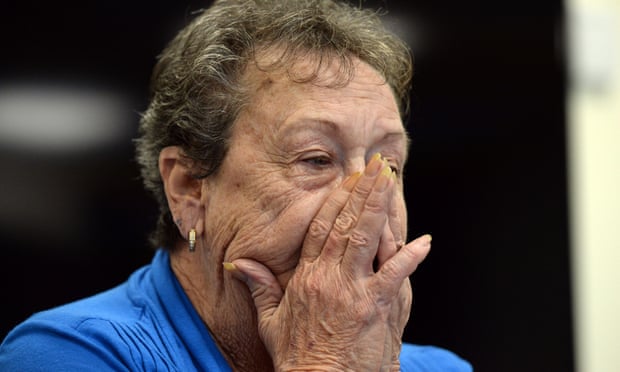
Yvonne D’Arcy, who has breast cancer, is at the centre of a legal challenge to prevent corporations from controlling human genetic material, focusing on the BRCA1 gene. Photograph: Dan Peled/AAP
A Queensland cancer patient has won her high court challenge against corporations owning human genes.
Yvonne D’Arcy took her fight against a US-based biotech company to Australia’s highest court after losing a federal court challenge.
Myriad Genetics has a patent over the BRCA1 gene, which is linked to an increased risk of hereditary breast and ovarian cancers.
Darcy’s lawyers had argued that genetic material is a product of nature, even where isolated from the body, and is therefore unpatentable.
They contended that allowing corporations to own patents over human genes stifled cancer research and allowed them to charge exorbitant rates for patients who wish to be tested for the BRCA1 mutation.
In an unanimous decision on Wednesday, the high court found that an isolated nucleic acid, coding for a BRCA1 protein, with specific variations from the norm that are indicative of susceptibility to breast cancer and ovarian cancer was not a “patentable invention”.
The federal court had dismissed Darcy’s appeal against a judge’s finding that the invention fell within the concept of a “manner of manufacture”. But the high court disagreed.
“While the invention claimed might be, in a formal sense, a product of human action, it was the existence of the information stored in the relevant sequences that was an essential element of the invention as claimed,” the judges said.
Darcy said she was “ecstatic” at the decision after a long legal battle.
Taking on a corporation had been a David and Goliath match-up, she said.
“I’m only a little person – but it’s not the size of the dog in the fight, it’s the size of the fight in the dog.”
D’Arcy said until the decision few people could afford testing “except for Angelina Jolie”, but the cost should now come down.
“For all those people who do have the genetic footprint, it’s a win for them,” she said. “Because now they’re forewarned and forearmed.”
D’Arcy’s two breast cancer diagnoses and one cervical cancer diagnosis are hormonally and not genetically based.
She said her opponents seemed motivated purely by their commercial bottom line. She said she never considered ditching her claim, despite the psychological toll of continuing legal procedures, because she knew she was in the right.
She hoped other countries would “see sense” and follow suit.
For now, she intended to celebrate.
“The bourbon bottle is going to come out tonight,” she said.
Please direct enquiries to Ben Wickham, Senior Executive Deputy Registrar Telephone: (02) 6270 6893 Email: bwickham@hcourt.gov.au Website: www.hcourt.gov.au
7 October 2015
D'ARCY v MYRIAD GENETICS INC & ANOR
[2015] HCA 35
Today the High Court unanimously allowed an appeal from a decision of the Full Court of the Federal Court of Australia. The High Court held that an isolated nucleic acid, coding for a BRCA1 protein, with specific variations from the norm that are indicative of susceptibility to breast cancer and ovarian cancer, was not a "patentable invention" within the meaning of s 18(1)(a) of the Patents Act 1990 (Cth) ("the Act").
The term "nucleic acid" includes two kinds of molecules, deoxyribonucleic acid (DNA) and ribonucleic acid (RNA), which are found inside a human cell. A gene is a functional unit of DNA which encodes a particular protein produced by the cell. The protein produced depends on the sequence of nucleotides. The BRCA1 gene codes for the production of a protein called BRCA1.
The first respondent filed a patent which contained 30 claims. Relevantly, Claims 1 to 3 concerned a nucleic acid coding for a BRCA1 protein, and with one or more specified variations from the norm in its nucleotide sequence, isolated from its cellular environment. Those specified variations, characterised as mutations or polymorphisms, are indicative of susceptibility to breast cancer and ovarian cancer.
Section 18(1)(a) of the Act requires that, for an invention to be patentable, it must be "a manner of manufacture" within the meaning of s 6 of the Statute of Monopolies. The appellant commenced proceedings in the Federal Court of Australia challenging the validity of Claims 1 to 3 on the basis that the invention claimed did not meet the requirement of s 18(1)(a).
The primary judge dismissed the appellant's challenge, holding that the invention fell within the concept of a "manner of manufacture". The Full Court dismissed an appeal from that decision. The Full Court held that an isolated nucleic acid was chemically, structurally and functionally different from a nucleic acid inside a human cell. The invention was a manner of manufacture because an isolated nucleic acid with the characteristics specified in Claims 1 to 3 resulted in an artificially created state of affairs for economic benefit.
By grant of special leave, the appellant appealed to the High Court. The Court unanimously allowed the appeal, holding that the invention claimed did not fall within the concept of a manner of manufacture. The Court held that, having regard to the relevant factors, an isolated nucleic acid, coding for the BRCA1 protein, with specified variations, is not a manner of manufacture. While the invention claimed might be, in a formal sense, a product of human action, it was the existence of the information stored in the relevant sequences that was an essential element of the invention as claimed. A plurality of the Court considered that to attribute patentability to the invention as claimed would involve an extension of the concept of a manner of manufacture which was not appropriate for judicial determination.
This statement is not intended to be a substitute for the reasons of the High Court or to be used in any later consideration of the Court’s reasons.
Trying to Lose Weight? Eat These 9 ThingsINTERESTICLE
Don’t Tempt Breast Cancer: 6 Life Choices to AvoidBREASTCANCER.ORG
5 Reasons You Should Stay Longer in Bed. You Might Be SurprisedABBOTT
Ever look yourself up? This new site is addicting. If you enter your name on this site, the results will surprise you.INSTANT CHECKMATE
